AUGUST 28, 2026 LUNAR ECLIPSE: 93% OF THE DISK IN EARTH'S SHADOW
Sixteen days after Spain's total solar eclipse, the Moon nearly vanishes but never goes fully dark. Where to watch, when moonset cuts the show short, and why this is not a blood moon.

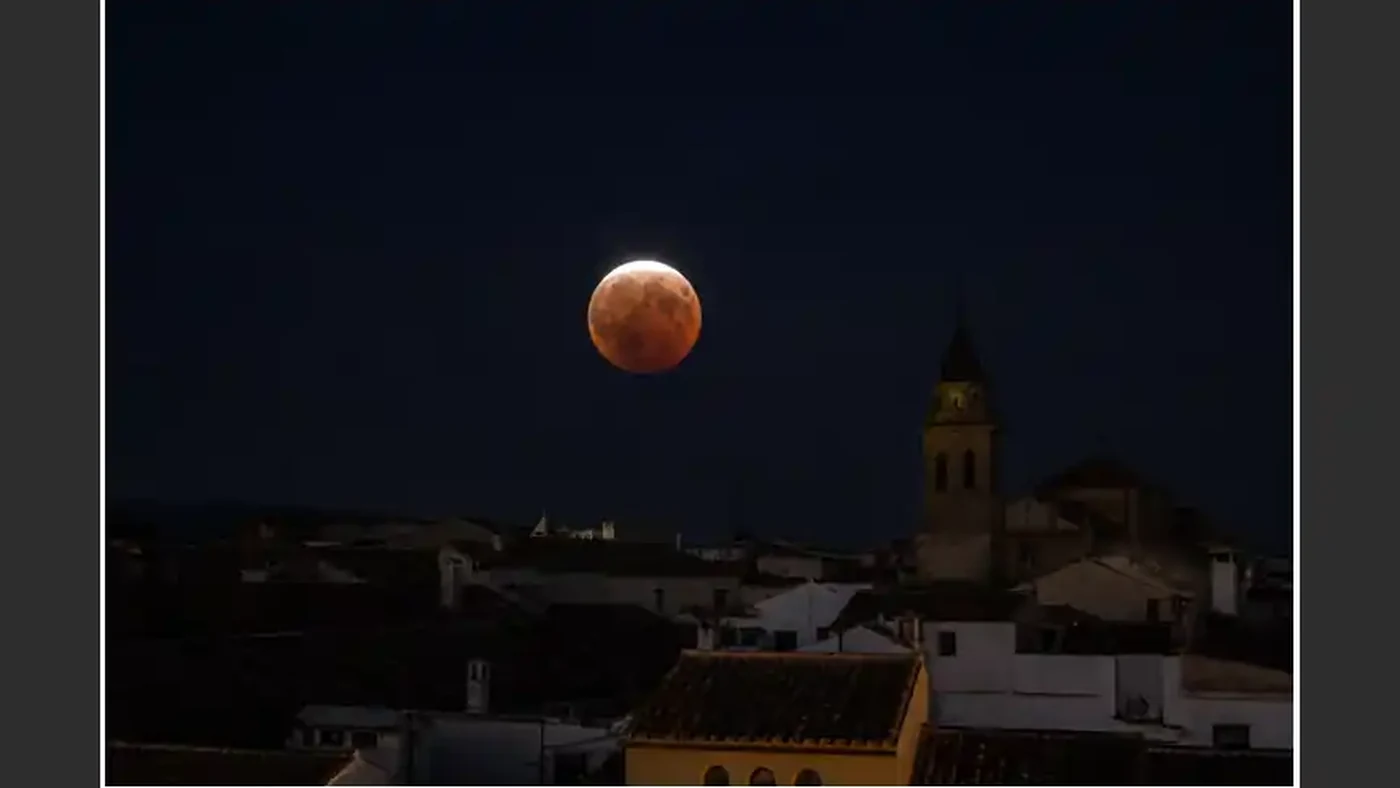
Table of Contents+
Sixteen days after millions across Spain watched the Sun disappear behind the Moon, the sky offers a quieter sequel. On August 28, 2026, Earth slides between the Sun and the full Moon. This time the Moon does not vanish. It dims, copper at the edges, with a bright white rim that refuses to go dark. EclipseWise lists the event as a partial lunar eclipse with magnitude near 0.93: roughly 93% of the lunar diameter inside the umbra, the inner shadow. Totality never arrives. Do not call it a blood moon.
That gap between expectation and outcome is the story. After the August 12 total solar eclipse, casual viewers assume the companion lunar show will "switch off" the Moon the same way. It will not. Spain's Instituto Geográfico Nacional and RTVE publish partial-phase times in CEST: about 04:34 to 07:52, maximum near 06:12. The Moon rises on August 27 near 21:01 and sets on August 28 near 07:47 for eastern Spain, the Balearics, and Melilla. Moonset cuts the finale short across eastern Spain. Western mainland Spain, the Canary Islands, and Ceuta can watch the shadow lift.
What happens during a deep partial eclipse
A lunar eclipse is Earth's shadow falling on the Moon. The penumbra is the outer, pale zone where only part of the sunlight is blocked. The umbra is the dark core. When the Moon crosses deep into the umbra but not completely, you get a partial eclipse. At magnitude 0.93, only a thin crescent of the lunar disk stays in direct sunlight. That sliver looks almost painfully bright against the dimmed portion, which is why photographers love these events even when headlines call them "almost total."
Observers in Europe, Africa, western Asia, and the Americas can see at least part of the partial phase. For the Americas, the eclipse falls on the evening of August 27. East Asia and Australia will miss out, as the event takes place during daylight hours. Always check local rise and set times. A perfect magnitude number means nothing if the Moon is below your horizon.
Spain: solar memory, lunar schedule, moonset trap
August 2026 packed the sky for Spain. August 12 brought a total solar eclipse across the peninsula. The Perseid meteor shower peaked around the same week. Then this lunar eclipse closes the sequence. The solar event demanded ISO 12312-2 eclipse glasses. The lunar event needs only your eyes, binoculars if you want, and a clear western horizon if you chase moonset.
IGN and RTVE timing in Central European Summer Time helps planners. Partial eclipse roughly 04:34 to 07:52, maximum near 06:12. Compare that to moonset near 07:47 on the east coast. The timing is unforgiving. You may see the deepest shadow and then lose the Moon to the horizon before the partial phase formally ends. Viewers in the Canary Islands get a few extra minutes. The conflict is geographic, not astronomical: the eclipse is real, but Spain is not one single viewing window.
Contrast that with March 3, 2026, when a total lunar eclipse turned the Moon blood-red for viewers who had night skies. That was a different geometry and a different headline. August 28 is the "almost" eclipse: dramatic, but not total.
How to watch without gear
Lunar eclipses are safe to view directly. No solar filters. No welding glass. Find the Moon, watch the shadow advance, note the color shift on the shaded portion. Penumbral shading begins subtly. Partial phase is obvious. If you plan to take photos, a tripod and a telephoto lens will help, but the event rewards patience more than equipment.
Build a simple log in English for practice: time, phase, cloud cover, rim brightness. Describing astronomical events calls for precise vocabulary: penumbra, umbra, magnitude, partial, moonset. That is the language link to English courses at Native Speakers: turn a public event into spoken description, not a textbook list.
Describe eclipses, films, and news in live conversation with native tutors. Book a free trial and practice the words you actually need this week.
Book Your Free Trial Lesson →Key words for sky headlines
Frequently Asked Questions
Is the August 28, 2026 lunar eclipse total?+
Do I need eclipse glasses?+
Why will eastern Spain miss the end?+
Where is the best global visibility?+
Related Guides & Insights